Tuesday, September 28, 2010

AN ACTUAL RAVEN BLADE

If it is true that we can only fight as well as we train, then the equipment we use in training takes on a special significance as well. Although I have read accounts of individuals who have even used popsicle sticks to train with -- and I find that commendable -- I also believe that training weapons should, as much as possible, resemble the weapons you expect to defend yourself with. I designed the above Carraca trainers with that in mind. They are modeled after the large carraca "sevillanas" manufactured by the cutlery firm of J.J. Martinez in Santa Cruz de Mudela, Spain.

The Carraca is the most recent design in a series of navaja trainers developed for use in our Acero Sevillano training. (Acero sevillano, or Sevillian steel, is the Andalucian art of defending oneself with the variety of edged weapons that evolved in the southernmost province of Spain.) Other navaja trainers include the Santolio and the Salvavirgo, a small knife carried by Andalucian women in a garter on their right legs.

The first few dozen Carracas that I received from my manufacturer sold out as soon as I arrived in Spain for this summer's Andalucian workshop (see the May 24 blog entry, below.) Recently I received a new delivery. The trainers, for those of you unfamiliar with them, measure 14.5 inches in length, 2.5 inches at the widest part of the belly, and come beautifully wrapped in navy blue para cord. Although it is very probable that you will buy other trainers that appeal to you in the future, you really would never have to get another navaja trainer after purchasing one of these. (And while the Carracas lack quillons, their size and weight make these trainers equally excellent for bowie knife practice.) Orders can be placed by visiting www.sevilliansteel.com, and sending us an e-mail from the contact page. Happy Training!

Tuesday, September 21, 2010

REMEMBERING 911

At the Raven Arts Institute, we have an annual tradition of commemorating 911 by training in Military Combatives for the entire month of September. While not directly related to the navaja or Spanish culture, Combatives is a western martial art that blends easily and effectively with other western fighting systems. Our particular focus this year was on the Combatives system of John Styers, author of the classic manual, COLD STEEL. For those not familiar with it, Cold Steel is a unique repository of fundamental -- and lethal -- methods of unarmed and armed combat: knife, baton, bayonet, and empty hands.
The knife Styers uses in the book is the iconic Marine Corps Ka-Bar, but the techniques he demonstrates are equally applicable with the navaja, the bowie, or any other blade-heavy knife.
Styers begins his knife chapter by reviewtng the proper stance and its tactical advantages, then quickly proceeds to the basics of using the Ka-Bar:
- the Thrust
- the Vertical Cut
- the Horizontal Cut
- the Hand Cut
From there, Styers moves on to demonstrate defensive actions with the knife, including the classic In Quartata, Passata Sotto, and the tactical use of distance. He then ends his knife instruction with a hierarchy of targets to be attacked with the knife, listing:
- the Hand
- the Heart
- the Throat
- the Chest, and
- the Back, between the scapulae.
While the Ka-Bar was the official knife issued to the Marines, the Fairbairn-Sykes dagger was the designated knife for our OSS, England's SOE, and the British Commandos. We train with both weapons, as they each have different designs which in turn offer different defensive/offensive attributes. Nonetheless, despite their different configurations, the two types of edged weapons handle quite intuitively.
In fact, the secret to efficiently using Combatives -- whether unarmed or armed -- is relying on your gross motor skills. This is what makes Combatives so teachable and so easily learned. So, if you don't yet train, 911 should be a great motivation for you to start. And if you already train, consider adding Military Combatives to whatever methods you already practice. Fortune favors the prepared!

Sunday, July 11, 2010

DECONSTRUCTING TO BUILD

This weekend's training session turned out to be a breakthrough event for me as well as for the session's participants. After three full hours of kenjutsu suburi, we switched gears and picked up tanto knives. The purpose in the change in weapons from Japanese swords to Japanese knives was not, as you might expect, to explore how to apply sword techniques with a shorter blade -- we've already done that extensively in the past. The purpose was to counterbalance the theoretical training with the sword with practical training with the knife!

We began, as all innovations begin, by changing the rules.

As a prelude we discussed how fighting arts devolve from artistic systems to near neanderthal applications once they enter the competitive arena. We've all witnessed this. The beautiful, sharp, and crisp movements of the karate dojo fall by the wayside when the exponent enters the ring and faces a liked-trained opponent. The reptile brain takes over, gross motor skills negate the sophisticated movements of the dojo, and the combat ends up looking like a slugfest with two fighters relying on just two or three techniques to repel or defeat the other. What happened to the dozens of other moves they learned in the years of training? Hmmm!

The same often happens in the western martial arts. Modern fencers are a good example of this. With the focus moving from self-defense to sport competition, fencing sophistication is sacrificed to the quickest attacks that can be used to merely touch the opponent. It, like the karate match, becomes a primitive and desperate game of Tag between the participants.
The phenomenon is now known as Adrenal Stress Syndrome (or by other similar terms) and has been researched and documented ad nauseum by contemporary martial academics. We know it happens and you can pick up books by Bill Kipp or Peyton Quinn to understand why. Our point, however, is that IT HAPPENS.

Predicatably, the Filipino knife-fighting arts of eskrima and kali also exhibit the tendency to play Tag in their competitions. These devolved ways of applying karate, fencing, and knife-fighting result in points and tournament winners but -- and of this you can be certain -- they will definitively not save your gluteus maximus on the street!

I will not go through the entire lesson from yesterday but we determined that to keep knife-fighting practical, as was the purpose of the session, we had to change how we typically practiced it in sparring. Ergo, the changing of "the rules." What was the breakthrough? We revised the standard as follows:

  • Change the beginning distance in combat from long to extreme close quarters
  • Change the guard from a traditional one to an upright one, with feet only twelve to 18 inches apart
  • Chamber the knife on the lead thigh instead of the lead hip
  • Avoid using the off-hand by tucking it behind the waist, inside the belt
  • Avoid all counter-cutting or "defanging the snake"; substitute partial or full body evasions as the only means of defense
  • Make only committed attacks against the opponent, and only when you have a clear, undefensed line of approach
  • Remain relaxed, fighting from a state of mushin, rather than from "active alertness."

As I'd predicted, there were no winners at the end of the session. Each participant "killed" his opponent at some point, only to "be killed" later by the same training partner. That was actually a perfect result since it showed that, regardless of any disparate levels of skill, this kind of realistic fighting levels the playing field.

We conducted an "after action report" (AAR) following the knife-fighting session to explore the findings that participants experienced. Each articulated the different epiphanies he had from fighting at extreme close quarters with a minimal use of traditional tactics. The one discovery they had in common was that all assumptions going in as to who was better were shattered by disregarding the rules, and the ultimate realization that you must fight for your life very differently than you fight for a trophy.

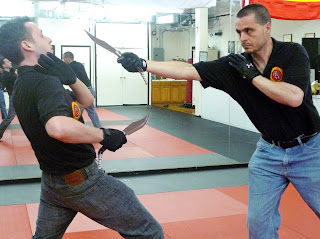
[Note: The above photo is not from the session described.]

Monday, June 28, 2010

ALBACETE: THE CITY OF THE NAVAJA

Nineteenth century literary accounts left to us by British and American travelers invariably record Albacete as the source city for navajas, sheath knives, and daggers. Although the city's reputation was based on the quality of its fighting steel, it was by no means the only venue that focused on the manufacture of navajas. The first chapter of the Manual del Baratero, in fact, lists the many other cities throughout Spain that were similarly dedicated to the production of small edged weapons. Today, Albacete's industry is primarily rivaled by knife manufacturing from Andujar and Santa Cruz, both of which also produce decent fare.

One could argue, however, that the premiere cutlers still reside in Albacete. Since I was going to stay there for a while. I decided to search out a cutler by the name of Sarrion. Sarrion's name is legend, even in the US, among connosieurs of fine navajas. I first heard of him ten years ago from Maestro Ramon Martinez. The Maestro had visited Albacete a decade or so prior and -- though not being a navaja stylist per se -- sought out Sarrion and acquired one of his formidable weapons. Maestro Martinez suggested that if I ever found myself in Albacete -- which is not at all near to my usual haunts in Andalucia -- I look up Sarrion and consider his wares. I said I would.

While everyone in Albacete seemed to have heard of Sarrion, the maestro cuchillero, very few knew if he still produced knives or was even alive. It was only the fact that the citizens of Albacete are very friendly and helpful that hept me undaunted in my search for this legendary knife artisan. In time, my persistence was rewarded.

At number 20 Albarderos Street, located two blocks from the cathedral, I found the Fabrica de Cuchillos Bienvenido, or the Bienvenido knife factory. [Yes, Bienvenido does mean "welcome" but it is also a common first name; and no, it was not an actual factory on a main street, but a factory outlet. The Spanish don't distinguish.] The proprietors, Bienvenido Gonzalez and his father, were very helpful in providing an extensive background on the current state of affairs.

As it turned out, Bienvenido has Sarrion as a neighbor. He informed me that while Sarrion is still alive, he recently retired due to advanced age and personal health complications that I cannot expand on in this post. Sarrion has two sons but neither is interested in carrying on the famiily tradition.

Bienvenido happened to have two remaining Sarrion navajas, which he was willing to sell me as part of a larger navaja purchase that I was making. The navajas, which I couldn't pass up, bear Sarrion's name engraved on the left side of their blades.

When I asked Bienvenido what the best way was to get back to the historical parador where I was staying, he smiled and told me that Sarrion's old storefront was right on the thoroughfare I would take to get back, the Avenida de Murcia. I could see it on the way.

Ten minutes later and halfway back, I found the place, now locked and neglected after years cutlery service to navaja aficionados. Its yellow sign, however, was still resplendent against the clear evening sky, persistent in letting the world know where it was that the retired cutler had once plied his time-honored trade. The Universe does indeed provide...

Friday, June 25, 2010

ODE TO THE SPANISH NAVAJA

Below is an old verse I originally composed in 2006. I've included here for those of you who have not yet seen it. It's not a sophisticated poem, but then neither is its subject...


I use a simple knife
Without fancy locks or Kraton© scales
It doesn’t have a space-age blade
That chops through cars or cuts through nails

I use a simple knife
It requires no special gadgets to hone
I use two hands to open it
But it did not cost me a fortune to own

I use a simple knife
It’s razor-sharp and locks with a clasp
Its looks won’t win high-tech awards
But its touch will make a strong man gasp

I use a simple knife
One called a navaja throughout Spain and France
It’s made from humble wood and steel
But when it strikes … you’ll have no second chance.

Thursday, June 17, 2010

THE OTHER SIDE OF THE COIN, Part III

As human beings we are multi-dimensional. There are many facets to us, and within those facets we can also express many temperaments. We are also different things to different people: husband to one; brother to another; instructor to one; student to another. In the same manner, it is vital that our martial skills be similarly multi-dimesional.

When I taught ninjutsu for Duncan-sensei at the Queens Village Pistol and Rifle Club, I believed I was multi-dimensional because I taught students the use of traditional weapons (tanto, hanbo, kusari, jo, and bo) in addition to various approaches to unarmed combat. I was, however, rudely awakened by Sensei when he unceremoniously informed me that I'd also better get skilled in the use of firearms -- and soon! (See prior post.)

At the time I was smug in my ability to effectively engage in defensive unarmed combat. The handgunners at the Club were smug in their ability to shoot us at 35 feet (if they ever had to.)

I quickly got over my smugness when I undertook extensive firearms training and eventually became certified as an NRA Pistol Instructor. (Regrettably, the Club's handgunners never saw the wisdom of becoming trained in unarmed combat skills. Perhaps they wore their guns in the shower.)

The point is, never rely on only one -- or even two -- defense systems. One or two systems are not enough. Understand that thugs and felons are allowed to practice martial arts in the prisons, so they're criminally-motivated and they're combatively-trained. Your Tae-Bo or Cardio-Kickboxing workouts are not going to save you.

Navaja students must learn to integrate unarmed combat into their knifework. Savate works very nicely. My fencing friends should also study knife or cane arts in addition to their epee, saber, and smallsword disciplines. Traditional martial artists should also explore boxing or military combatives, the use of chemical sprays, and expandable batons.

And everyone -- political leanings notwithstanding -- should have a fundamental working understanding of firearms use.

Don't become complacent with your current skills, no matter how masterfully you perform them -- and don't neglect to develop The Other Side of the Coin!

OTHER SIDE OF THE COIN, Part II

At a very young age during my tutelage under him, Shihan Ronald Duncan finished instructing a lesson on some obscure ninjutsu weapon and. turning to face us, emphatically revealed, "Hands and feet are not enough."

This seemed to me to be a remarkably obvious thing to say, given that I was there to study ninjutsu which, almost by definition, focuses on a wide array of exotic Japanese weaponry. Hmm?

A few years later, as I became a candidate for my first black belt, Sensei informed me that I would have to apply for and acquire a NYC Pistol Permit as well. Huh? Throughout my entire time training, the handgun had always been held by the student in the attacker's role, the uke who represented "the Bad Guy."

The defender, tori, was the Good Guy. We were all there to be Good Guys, capable of using ancient Japanese arts to defend ourselves. Why did I need to acquire a gun permit to qualify for my black belt evaluation? Guns, I reminded Sensei, were the purview of the bad guys, the guys we learned many disarms to defend against!

In an uncharacteristically patient manner, Sensei explained:

"The ninja was a master of all the weapons of his time; to become a master of weapons you must learn to master all of weapons of your time. Of course it's great that you can use a katana, a tanto, and a hanbo expertly, but you'll rarely face those in the street. Today's cowards will use a handgun, so you must know how they work in order to contend against them.
"Nor is your knowledge of disarms enough. You must learn how to load a handgun, how to unload it, how to take it apart, and how to put it back together. Now go and apply for that permit or you'll remain a brown belt for the rest of your life!"

This was my second encounter with "The Other Side of the Coin."
______________________
At this point, readers who are navaja aficionados may be asking, "What has all this Eastern arts stuff have to with the art of la navaja?" Well, effective combat strategies know no ethnic borders!